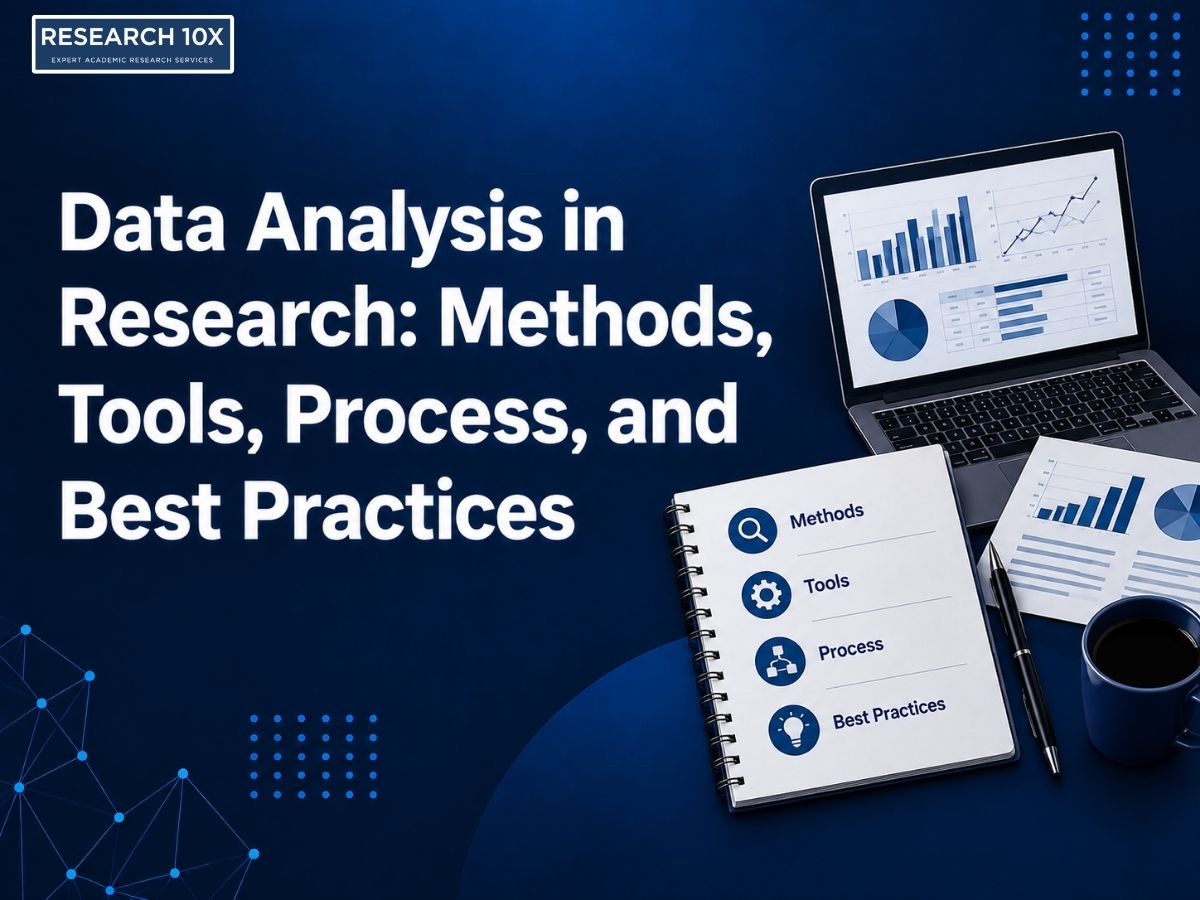
Data analysis is a critical stage of any research project because it allows researchers to transform raw information into meaningful findings. Whether a study involves survey responses, experimental observations, interview transcripts, or secondary datasets, the right analytical approach is essential for producing reliable and interpretable results.
At Research10X, we provide Data Analysis Services covering quantitative, qualitative, and mixed-methods research. Our team combines research methodology, statistical expertise, and analytical tools to help researchers understand their data and present their findings clearly.
From data preparation and statistical analysis to qualitative coding, interpretation, visualization, and reporting, we tailor our approach to the objectives and methodology of each research project.
What Is Data Analysis in Research?
Data analysis is the process of organizing, examining, interpreting, and presenting collected data to answer research questions and evaluate hypotheses.
The appropriate approach depends on several factors, including:
Research objectives
Research questions and hypotheses
Study design
Type of data
Sample characteristics
Measurement scales
Research methodology
Statistical or qualitative requirements
At Research10X, we do not apply the same analytical technique to every project. We first understand the research framework and dataset before determining which methods and tools are most appropriate.
For researchers who need guidance at the planning stage, our Research Methodology and Consulting Services provide additional guidance on research design, methodology, and analytical approaches.
What Types of Research Data Do We Analyze?
Different research projects generate different types of datasets. At Research10X, our data analysis expertise covers a broad range of quantitative and qualitative data.
Quantitative Research Data
We can work with datasets such as:
Survey and questionnaire responses
Experimental data
Observational data
Cross-sectional datasets
Longitudinal datasets
Panel data
Secondary research datasets
Qualitative Research Data
For qualitative studies, we can work with:
Interview transcripts
Focus group discussions
Open-ended responses
Textual data
Documents and other text-based sources
Mixed-Methods Data
When a research project combines quantitative and qualitative methodologies, we can support the analysis of both forms of data while keeping the analytical approach aligned with the overall research design.
Quantitative Data Analysis Methods We Use
Quantitative research requires careful selection of statistical methods based on the research question and characteristics of the dataset.
At Research10X, our quantitative analysis can include several techniques.
Descriptive Statistics
Descriptive statistics provide an overview of the dataset and help researchers understand the distribution and characteristics of their variables.
Depending on the research requirements, we may analyze:
Frequencies
Percentages
Mean
Median
Standard deviation
Minimum and maximum values
Distribution patterns
Correlation Analysis
Correlation analysis allows researchers to examine the direction and strength of relationships between variables.
We consider the characteristics of the variables and research design when selecting and interpreting the appropriate correlation technique.
Regression Analysis
Regression analysis can be used to investigate relationships between variables and determine whether one or more predictors are associated with an outcome.
Depending on the research design, our analysis may include:
Linear regression
Multiple regression
Logistic regression
Panel data regression
Time series regression
Regression diagnostics
Researchers working specifically on regression-based projects can also explore our Regression and Statistical Analysis Services for more specialized statistical consulting.
Hypothesis Testing
We conduct appropriate statistical tests to evaluate research hypotheses based on the study design, variables, sample characteristics, and underlying assumptions.
These may include:
t-tests
ANOVA
MANOVA
Chi-square tests
Non-parametric tests
Other research-specific statistical techniques
Reliability and Validity Analysis
For questionnaire-based studies, we can assess the reliability of measurement instruments and examine relevant validity considerations.
Depending on the research framework, this may include Cronbach’s Alpha, factor analysis, and other measurement-related techniques.
Factor Analysis
When a study involves multiple observed variables representing underlying constructs, factor analysis may be appropriate.
Our analysis can include:
Exploratory Factor Analysis (EFA)
Confirmatory Factor Analysis (CFA)
Factor loading interpretation
Construct-related analysis
Qualitative Data Analysis
Quantitative analysis is not appropriate for every research question. Qualitative studies often require researchers to identify themes, patterns, concepts, and relationships within textual or interview-based data.
At Research10X, we can support qualitative analysis involving:
Interview transcripts
Focus group discussions
Open-ended survey responses
Documents
Textual datasets
Depending on the research methodology, qualitative analysis may involve coding, categorization, thematic analysis, pattern identification, and interpretation of emerging themes.
Mixed-Methods Data Analysis
Mixed-methods research combines quantitative and qualitative approaches to provide a broader understanding of a research problem.
For these projects, our team considers how the two forms of data are connected within the overall research design.
We can support researchers with:
Quantitative statistical analysis
Qualitative coding and thematic analysis
Separate interpretation of quantitative and qualitative findings
Integration of findings
Tables and visualizations
Research reporting
Our focus is to ensure that the analytical methods remain consistent with the mixed-methods research framework.
Software and Tools We Use for Data Analysis
The software selected for a research project depends on the type of data, methodology, statistical technique, and analytical requirements.
Statistical Analysis Software
Our statistical toolkit includes:
IBM SPSS
AMOS
SmartPLS
R / RStudio
Stata
EViews
Python
For researchers specifically working with SPSS, our SPSS Data Analysis Services cover statistical testing, data analysis, output interpretation, and academic reporting.
Qualitative Analysis Software
For qualitative and text-based research, we can work with:
NVivo
ATLAS.ti
MAXQDA
Visualization and Supporting Tools
Depending on the project, we may also use:
Excel
Power BI
Tableau
VOSviewer
Jamovi
JASP
PROCESS Macro
We select the software based on the research requirements rather than assuming that one tool is suitable for every project.
Our Data Analysis Process
At Research10X, we follow a structured process to ensure that the analysis remains connected to the research objectives from beginning to end.
Step 1: Understanding Your Research Objectives
We begin by reviewing your research questions, objectives, hypotheses, methodology, variables, and overall study design.
This allows us to understand what the research is intended to investigate before selecting analytical techniques.
Step 2: Data Cleaning and Preparation
Before analysis, we review the dataset for issues such as:
Missing values
Duplicate or inconsistent records
Incorrect coding
Outliers
Variable inconsistencies
Data formatting issues
Proper preparation provides a stronger foundation for subsequent analysis.
Step 3: Selecting Appropriate Analysis Methods
We identify suitable quantitative, qualitative, or mixed-methods techniques based on the research design and characteristics of the available data.
Step 4: Conducting the Analysis
Our team performs the selected statistical or qualitative analysis using appropriate software and methodologies.
For quantitative projects, this may involve statistical testing, regression, correlation, reliability analysis, factor analysis, or other techniques.
For qualitative research, the process may involve coding, categorization, thematic analysis, and interpretation.
Step 5: Interpreting the Results
We examine the outputs and connect the findings to your research questions, hypotheses, and objectives.
Our focus is not simply on producing statistical tables or software outputs. We aim to make the findings understandable within the context of the research.
Step 6: Reporting and Final Delivery
We organize relevant findings into clear tables, charts, visualizations, and written interpretations according to the requirements of your thesis, dissertation, research paper, or other research project.
Why Is Proper Data Analysis Important?
Good data analysis can significantly influence the quality and credibility of research findings.
At Research10X, we focus on several important considerations:
Methodological Accuracy
The analytical method should correspond with the research design, objectives, variables, and type of data.
Reliable Findings
Appropriate data preparation and statistical procedures reduce the likelihood of analytical errors that could affect research conclusions.
Meaningful Interpretation
Researchers need to understand what their findings indicate rather than simply reporting numerical outputs.
Clear Academic Reporting
Statistical and qualitative findings should be presented in a format that readers can understand and evaluate.
Alignment With Research Objectives
The analysis should directly contribute to answering the research questions and evaluating the hypotheses established within the study.
Why Choose Research10X for Data Analysis?
At Research10X, we combine data analysis expertise with an understanding of academic research methodology.
Our approach includes:
PhD-level research and statistical expertise
Quantitative, qualitative, and mixed-methods analysis
Structured data preparation and analysis
Appropriate method selection based on research objectives
Clear interpretation of statistical and qualitative findings
Academic and publication-oriented reporting
Confidential and ethical research practices
Support for doctoral, postgraduate, academic, and professional research
We believe that effective data analysis should be accurate, methodologically appropriate, transparent, and understandable.
Who Can Benefit From Our Data Analysis Services?
Our services are suitable for researchers working across different academic and professional disciplines.
We work with:
PhD scholars
Master’s students
MBA, MSc, and MA students
Academic researchers
University faculty
Journal publication authors
Industry professionals conducting research projects
Our analytical expertise can be applied to research in areas such as:
Psychology
Education
Business administration
Economics
Sociology
Public health
Nursing
Management
Environmental studies
Social sciences
If your project also requires broader thesis guidance, you can explore our Thesis Consulting and Mentorship Services for additional research support.
Get Professional Data Analysis Support From Research10X
Effective data analysis is about more than processing a dataset. It involves choosing appropriate methods, applying them correctly, evaluating relevant assumptions, interpreting findings, and presenting results in a way that supports the overall research objectives.
At Research10X, we provide structured Data Analysis Services for quantitative, qualitative, and mixed-methods research. Our team works with researchers to transform raw data into meaningful findings while maintaining methodological accuracy and clear academic reporting.
Whether you are working on a PhD thesis, dissertation, research paper, survey-based study, or professional research project, we can review your requirements and recommend an appropriate analytical approach.
Ready to Discuss Your Research Data?
Share your research objectives, dataset, questionnaire, hypotheses, or methodology with our team. We will review your requirements and discuss the most appropriate approach for analyzing and interpreting your research data.
Get in touch with Research10X today to discuss your data analysis requirements and take the next step toward clear, reliable, and research-driven findings.
Frequently Asked Questions About Data Analysis Services
1. What does your Data Analysis Service include?
At Research10X, our data analysis services can include data preparation, statistical analysis, qualitative analysis, interpretation, visualization, and academic reporting, depending on the project requirements.
2. Do you analyze both quantitative and qualitative data?
Yes. We provide quantitative, qualitative, and mixed-methods data analysis based on the methodology and objectives of each research project.
3. Can you create charts and visualizations from research data?
Yes. Depending on the project, we can prepare appropriate tables, charts, graphs, and other visualizations to present research findings clearly.
4. Can you analyze survey data for a dissertation?
Yes. We can analyze questionnaire and survey datasets using appropriate statistical techniques based on the dissertation’s research questions, hypotheses, variables, and methodology.
5. Which software do you use for data analysis?
Our toolkit includes IBM SPSS, AMOS, SmartPLS, R/RStudio, Stata, EViews, Python, NVivo, ATLAS.ti, MAXQDA, Excel, Power BI, Tableau, Jamovi, JASP, and other relevant tools.
6. How do you select the right statistical method?
We consider the research objectives, questions, hypotheses, study design, variable types, measurement scales, sample characteristics, and statistical assumptions before recommending an analytical method.
7. How do you maintain research data confidentiality?
At Research10X, we treat research datasets and project information as confidential and follow appropriate practices for responsible data handling.
8. Do you provide revisions after the analysis?
Yes. Where revisions are included within the agreed project scope, we can review feedback and make appropriate analytical or reporting adjustments.
9. How long does data analysis take?
Turnaround time varies according to the size and complexity of the dataset, analytical techniques required, project scope, and reporting requirements. We provide an estimated timeline after reviewing the project requirements.