
A literature review should do much more than summarize what previous researchers have written. Its real purpose is to connect ideas, compare findings, evaluate different viewpoints, and explain where knowledge is still incomplete. That’s exactly what a synthesis-driven literature review achieves. Instead of presenting one study after another, it builds a logical discussion that leads readers toward your research problem.
Many postgraduate and doctoral researchers struggle at this stage. They spend weeks reading journal articles, only to end up with pages of isolated summaries that don’t explain how the studies relate to one another. As a result, the literature review feels descriptive rather than analytical, and identifying genuine research gaps becomes difficult.
If you’re facing the same challenge, you’re not alone. At Research10X, we’ve worked with researchers who needed guidance in transforming scattered notes into a structured, critical literature review that supports their research objectives. Whether you’re preparing your first chapter or refining a nearly completed draft, understanding synthesis is the key to writing a stronger review.
If you’re looking for expert Literature review consulting, Research10X provides tailored guidance to help you organize evidence, synthesize research, and present clear academic arguments.
What Is a Synthesis-Driven Literature Review?
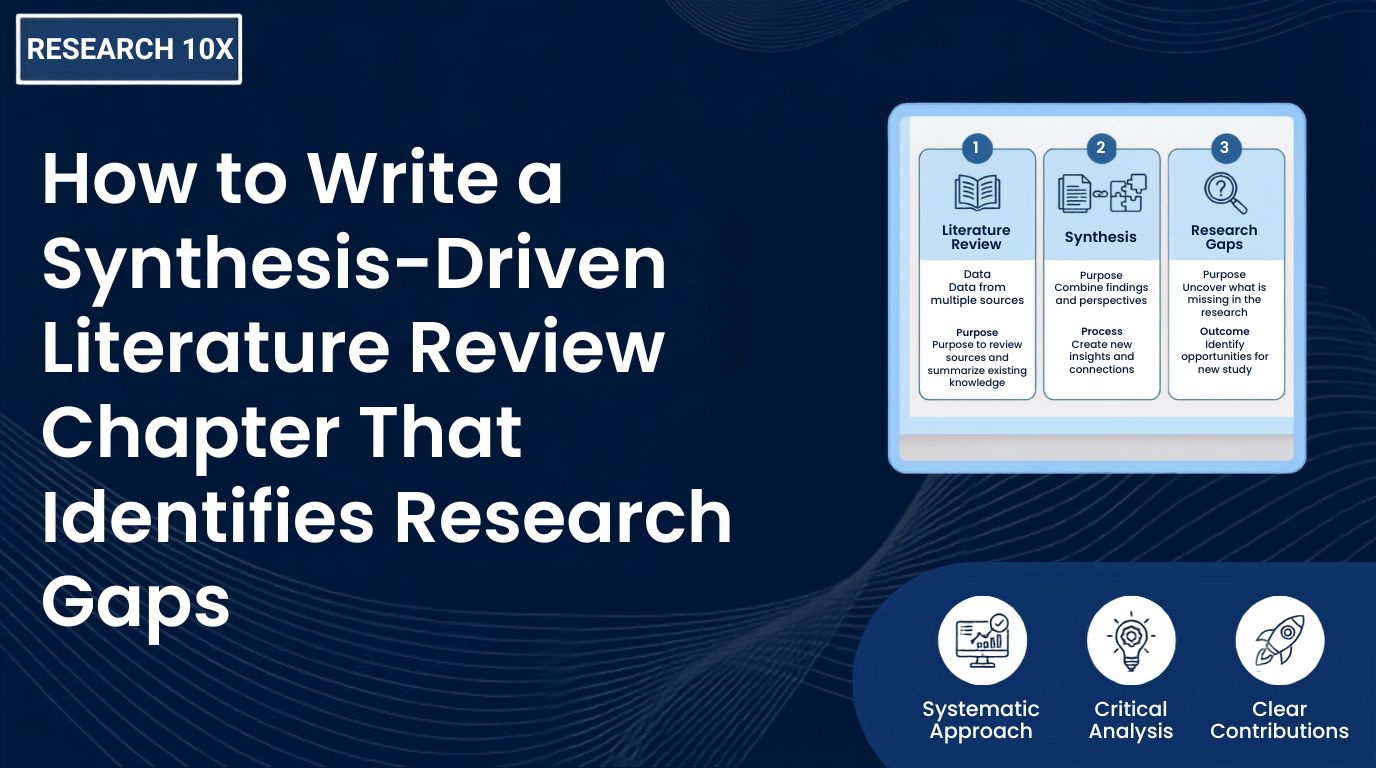
A synthesis-driven literature review is a chapter that combines findings from multiple research studies to explain what is already known, what researchers disagree about, and what still requires investigation.
Unlike a traditional summary, synthesis focuses on relationships between studies instead of discussing each paper separately.
For example, instead of writing:
- Study A found positive results.
- Study B found different results.
- Study C supported Study A.
A synthesis-driven review explains:
“While several studies reported positive outcomes under controlled conditions, others found inconsistent results when different participant groups or methodologies were used. This suggests that contextual factors may influence the effectiveness of the proposed approach.”
Notice the difference?
The second version connects evidence, evaluates differences, and naturally moves toward identifying a research gap.
That’s what examiners expect to see.
Why Simply Summarizing Sources Weakens Your Literature Review
One of the most common mistakes researchers make is creating what many supervisors call an “annotated bibliography in disguise.”
The chapter becomes a sequence like this:
- Author A said…
- Author B found…
- Author C concluded…
- Author D suggested…
Although each study is described correctly, the reader never understands how these findings relate to one another.
A weak literature review often shows these warning signs:
- Every paragraph discusses only one paper.
- Little or no comparison between researchers.
- Findings are presented without evaluation.
- Contradictory evidence isn’t discussed.
- The chapter doesn’t explain why your study is needed.
When this happens, readers finish the chapter knowing what previous researchers did—but not why your research matters.
How Do You Critically Synthesize Sources Instead of Just Summarizing Them?
This is one of the most frequently asked questions by research students, and the answer is surprisingly practical.
Critical synthesis means reading multiple studies together rather than individually.
Instead of asking:
“What does this paper say?”
Ask:
- How does this study compare with others?
- Which findings are consistent?
- Where do researchers disagree?
- Why are their conclusions different?
- Which questions remain unanswered?
When several papers discuss the same concept, don’t explain each one separately.
Instead, group similar findings together before discussing differences.
For example:
Several studies reported that collaborative learning improves student engagement. However, the reported improvement varied considerably depending on sample size, institutional setting, and assessment methods. More recent research also suggests that technology integration may influence these outcomes, although existing evidence remains inconsistent.
This paragraph synthesizes multiple studies into one coherent discussion rather than treating them individually.
Build Your Literature Review Around Themes, Not Authors
One of the easiest ways to improve synthesis is to organize your chapter by themes.
This approach is commonly known as a thematic literature review, where research is grouped according to concepts instead of publication order.
For example, if your research focuses on digital learning, your chapter might include themes such as:
- Student engagement
- Learning outcomes
- Technology adoption
- Instructor perceptions
- Assessment methods
Within each theme, compare different researchers, discuss similarities, identify disagreements, and evaluate the strength of existing evidence.
This structure helps readers understand the bigger picture rather than following a long list of individual studies.
It also creates a smoother transition toward explaining why your research is necessary.
Use a Literature Review Matrix Before You Start Writing
Many experienced researchers don’t begin writing immediately after reading journal articles.
Instead, they organize the evidence first.
A dissertation literature review matrix is one of the simplest tools for doing this.
Rather than keeping dozens of disconnected notes, create a table that records:
Study | Research Objective | Method | Key Findings | Limitations | Theme |
Study A | Investigated X | Survey | Positive relationship | Small sample | Theme 1 |
Study B | Examined X | Interviews | Mixed findings | Single institution | Theme 1 |
Study C | Evaluated X | Mixed methods | Contradictory evidence | Limited duration | Theme 2 |
Once several studies are entered into the matrix, patterns become much easier to identify.
You’ll quickly notice:
- recurring conclusions,
- conflicting findings,
- methodological differences,
- under-researched populations,
- and opportunities for future research.
This process makes synthesis significantly easier because you’re comparing evidence before writing instead of trying to organize information while drafting.
How to Identify Genuine Research Gaps Instead of Inventing Them
Many researchers assume that a research gap simply means “no one has studied this topic.”
In reality, genuine research gaps take several forms.
A research gap may exist because:
- previous studies produced conflicting findings,
- different methodologies generated inconsistent results,
- certain variables have rarely been examined together,
- existing evidence focuses on limited contexts,
- newer developments have not yet been explored,
- or earlier studies have important methodological limitations.
Strong researchers don’t force gaps into their literature review.
Instead, they allow the evidence to reveal them naturally.
A well-written synthesis gradually shows readers why additional investigation is needed without making unsupported claims.
How to Connect Themes Into One Coherent Literature Review Chapter
Writing each theme well is only half the job. Your chapter should also flow naturally from one section to the next. Readers shouldn’t feel like they’re moving between unrelated topics.
One effective way to achieve this is by using transition paragraphs. Instead of ending one theme and immediately introducing another, briefly explain how they are connected.
For example:
“While existing studies have established the importance of organisational culture, researchers have also explored how leadership influences the same outcomes. Examining these perspectives together provides a broader understanding of the current evidence.”
Small transitions like this improve readability and reinforce the logical progression of your argument. They also help demonstrate that your literature review is a connected discussion rather than a collection of separate sections.
Remember, each theme should contribute to answering one central question:
How does the existing literature justify my research?
Common Mistakes That Prevent a Synthesis-Driven Literature Review
Even researchers who read extensively can weaken their literature review by making avoidable mistakes. Being aware of these issues before you start writing can save significant revision time.
Treating every article equally
Not every source contributes the same value. High-quality, peer-reviewed research should form the foundation of your discussion, while less robust studies can be used to provide additional context where appropriate.
Writing author-by-author paragraphs
If every paragraph begins with an author’s name, you’re probably summarising rather than synthesising. Focus on discussing ideas, patterns, and evidence instead of individual studies.
Ignoring contradictory findings
Differences between studies often reveal valuable research opportunities. Rather than avoiding conflicting evidence, explain why results may differ. Variations in methodology, sample characteristics, research settings, or theoretical perspectives can all influence findings.
Forgetting to evaluate the evidence
A strong literature review doesn’t simply report previous findings. It assesses the strengths, weaknesses, consistency, and limitations of the existing research.
Introducing research gaps without evidence
A convincing research gap emerges from your analysis of the literature. Avoid statements such as “no research exists” unless you can confidently support them through a comprehensive review.
When Should You Seek Literature Review Guidance?
Writing a synthesis-driven chapter takes time, practice, and careful planning. Sometimes researchers know what they want to say but struggle to organise the evidence into a coherent academic discussion.
You may benefit from professional guidance if you:
- Have read dozens of papers but don’t know how to structure your chapter.
- Keep writing summaries instead of critical discussions.
- Find it difficult to connect themes logically.
- Aren’t confident about identifying research gaps.
- Receive supervisor feedback that your review is “too descriptive.”
- Need help improving clarity before submission.
Research10X offers Literature review consulting to help researchers develop well-structured, synthesis-driven literature reviews that align with academic expectations. Whether you’re starting from scratch or revising an existing chapter, expert feedback can help strengthen your critical analysis and overall structure.
You can also explore our Academic Research Consulting solutions for broader research guidance or browse our Academic Research Support Services to find assistance for every stage of your research journey.
Before You Submit: A Quick Checklist for a Strong Literature Review
Ask Yourself These Questions
- Have I grouped studies into themes instead of discussing one paper at a time?
- Do I compare findings rather than simply describe them?
- Have I evaluated the strengths and limitations of previous research?
- Does every section contribute to identifying a clear research gap?
- Have I supported every major claim with relevant academic evidence?
- Does my literature review naturally justify the need for my research?
- Have I avoided unsupported statements such as “no research exists”?
- Is my conclusion clearly linked to my research objectives?
If you can confidently answer “yes” to these questions, your literature review is likely moving beyond summary and towards critical synthesis.
Final Thoughts on Writing a Synthesis-Driven Literature Review That Identifies Research Gaps
A high-quality synthesis-driven literature review is built on critical thinking rather than extensive summarising. It connects ideas across multiple studies, evaluates existing evidence, highlights inconsistencies, and clearly explains why further research is necessary.
Developing this skill takes practice, but the effort is worthwhile. A well-synthesised chapter strengthens your entire dissertation by providing a clear academic foundation for your research questions, methodology, and contribution to the field.
If you’re finding it difficult to transform individual paper summaries into a coherent critical discussion, Research10X can help. Our experienced team provides practical guidance to help researchers organise evidence, develop stronger arguments, and produce literature reviews that meet academic standards.
Struggling to turn isolated paper summaries into a coherent critical synthesis? Book a literature review strategy call with Research10X today and take the next step towards a stronger dissertation.
Frequently Asked Questions
Q1. How do I critically synthesize sources instead of just summarizing them in my literature review?
Instead of discussing one paper at a time, compare findings across multiple studies. Group similar research into themes, evaluate agreements and disagreements, explain conflicting evidence, and connect everything to your research objectives and the gaps your study aims to address.
Q2. How do I know if I'm writing a thematic literature review or a synthesis-driven literature review?
If you’re simply organising studies into themes, you’re writing a thematic literature review. To make it synthesis-driven, you should also compare findings, evaluate the evidence, identify patterns or contradictions, and explain how the literature leads to your research gap.
Q3. How can I identify research gaps in my PhD literature review?
Start by looking for conflicting findings, methodological limitations, underexplored variables, or unanswered questions across multiple studies. When identifying research gaps PhD researchers should focus on patterns in the evidence rather than assuming a gap exists because few studies are available.
Q4. Do I need to create a dissertation literature review matrix before I start writing?
A dissertation literature review matrix isn’t mandatory, but it can make the writing process much easier. It helps you organise studies, compare key findings, identify recurring themes, and develop a stronger synthesis before drafting your literature review.