
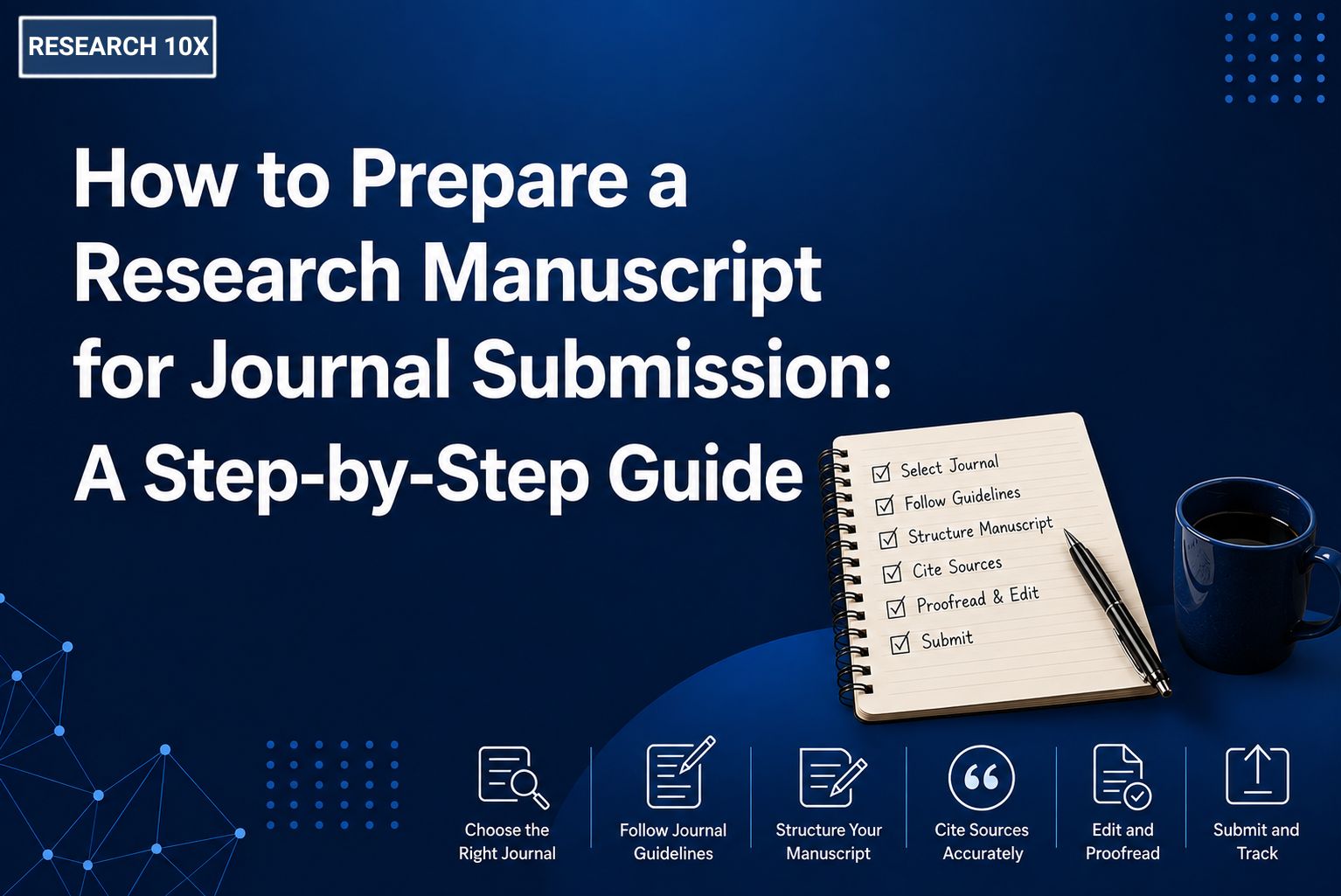
Preparing a research manuscript for journal submission involves much more than putting your research findings into a document. A strong manuscript needs a clear structure, accurate methodology, appropriate analysis, consistent references, and careful attention to the journal’s requirements.
For researchers, PhD scholars, academics, and postgraduate students, preparing research manuscript for journal submission can feel complicated, especially when each journal follows different formatting and submission rules. A well-prepared manuscript, however, makes it easier for editors and reviewers to understand the research and evaluate its contribution.
If you need support with manuscript development, analysis, or presentation, Research10X provides academic research solutions designed to help researchers prepare their work more effectively for publication.
What Is a Research Manuscript?
A research manuscript is the complete version of a research study prepared for submission to an academic journal. It presents the research problem, existing literature, methodology, findings, interpretation, and conclusions in a format that follows the requirements of the target journal.
A manuscript is usually prepared before publication. Once submitted, it may go through editorial screening, peer review, revisions, acceptance, and final publication.
This means a manuscript needs to work for two audiences at the same time: the journal editor who decides whether it is suitable for review and the reviewers who evaluate the quality and contribution of the research.
What Should a Journal Manuscript Include?
The exact structure varies between disciplines and journals, but most research manuscripts contain several core sections. Before starting your journal manuscript preparation, check the target journal’s author guidelines because some journals may require additional sections or a different order.
Title
The title should clearly communicate what the study investigates. Keep it specific without making it unnecessarily long.
A good research title generally identifies the main topic, population, variables, methodology, or context when these details are important.
Avoid vague titles such as “A Study of Research Methods.” A more informative title might explain the relationship being investigated or the specific research problem addressed.
Abstract
The abstract provides a short overview of the entire study. It normally includes the research purpose, methodology, major findings, and conclusion.
Many journals impose a specific word limit, so check the submission requirements before writing it.
Keywords
Keywords help readers and search systems understand the main subjects covered by your research.
Choose terms that accurately represent the study rather than simply repeating words from the title. Include important concepts, variables, methods, or populations relevant to your research.
Introduction
The introduction explains the research problem and establishes why the study is needed.
A strong introduction generally moves from the broader research context toward the specific problem, research gap, objectives, research questions, or hypotheses.
By the end of the introduction, the reader should understand what the study investigates and why the research is worth conducting.
Literature Review or Background
The literature review explains what previous researchers have established and where gaps or unresolved issues remain.
Rather than listing studies one after another, connect the literature to your research problem. Explain areas of agreement, disagreement, limitations, and gaps that your study addresses.
Methodology
The methodology explains how the research was conducted.
Depending on the study, this section may include the research design, population, sample, sampling method, data collection process, instruments, variables, ethical considerations, and analytical techniques.
The methodology should provide enough information for readers to understand how the findings were produced.
Results
The results section presents the findings of the research without unnecessarily interpreting them.
Use tables, figures, statistical results, or qualitative themes where appropriate. Every table and figure should serve a clear purpose and be referenced in the manuscript.
Discussion
The discussion explains what the findings mean.
Connect your results with previous research and explain whether your findings support, extend, or differ from earlier studies. You should also discuss possible reasons for unexpected findings.
Conclusion
The conclusion brings the research together by answering the main research questions and highlighting the study’s contribution.
Avoid introducing completely new findings in this section. Depending on journal requirements, you may also discuss implications, recommendations, and directions for future research.
References
The reference list contains the sources cited throughout the manuscript.
Use the citation style required by the journal and make sure every in-text citation has a corresponding reference entry. Likewise, remove references that are not cited in the manuscript if the journal requires a strictly matched reference list.
How to Prepare Your Research Manuscript Step by Step
A systematic approach can make research manuscript preparation easier and reduce avoidable problems during submission.
Choose the Right Journal
Journal selection should happen before you finalize the manuscript, not after.
Look for journals that publish research similar to yours. Review their scope, recent articles, subject area, methodological preferences, audience, publication model, and article types.
Pay particular attention to the journal’s aims and scope. A well-written paper can still be rejected if it does not fit the journal.
Also check whether the journal accepts the type of manuscript you have prepared, such as an original research article, systematic review, case study, or methodological paper.
Read the Journal’s Author Guidelines
Once you have shortlisted a journal, read its author guidelines carefully.
Check requirements such as:
- Manuscript word count
- Abstract length
- Required headings
- Referencing style
- Font and formatting requirements
- Table and figure specifications
- Supplementary files
- Ethical declarations
- Conflict-of-interest statements
- Data availability statements
- Research reporting guidelines
- Submission file format
Do not assume that the formatting rules of one journal apply to another.
Structure Your Manuscript
Organize the manuscript according to the target journal’s preferred structure.
For many empirical studies, a logical flow is:
Introduction → Literature/Background → Methodology → Results → Discussion → Conclusion → References
However, follow the journal’s specific requirements if they differ.
At this stage, check whether each section contributes directly to the research objectives. Remove unnecessary repetition and make sure the argument progresses logically from the research problem to the conclusion. If you need help developing or structuring your paper before submission, you can explore Research Paper Consulting for additional research support.
Format Tables and Figures
Tables and figures should make your findings easier to understand.
Give every table and figure a clear number and descriptive title. Mention each one in the manuscript and place it according to the journal’s instructions.
Before submission, check:
- Are all tables and figures referenced in the text?
- Are titles and captions clear?
- Are numbers accurate?
- Are units reported consistently?
- Are statistical symbols explained?
- Is the resolution suitable for publication?
- Does the journal require separate figure files?
A visually confusing table can make otherwise strong findings difficult to evaluate.
Check References and Citations
Reference errors are among the easiest problems to prevent.
Review every citation and reference carefully. Confirm author names, publication years, article titles, journal names, volume and issue information, page numbers, and DOI details where required.
Also check whether the journal has specific requirements for recent sources, reference formatting, or citation limits.
Reference management tools can make this process easier, but automated formatting should still be manually checked before submission.
How to Write a Journal-Ready Abstract
A journal-ready abstract should communicate the core of the study without requiring the reader to open the full manuscript.
A useful structure is:
- Purpose: What problem does the research address?
- Method: How was the study conducted?
- Results: What were the most important findings?
- Conclusion: What do the findings mean?
For example, instead of saying that “the study discusses employee satisfaction,” explain what was investigated, how it was studied, and what the research found.
Avoid introducing information in the abstract that does not appear in the manuscript. Also check whether the journal requires a structured abstract with headings such as Background, Methods, Results, and Conclusion.
Because editors and readers often use the abstract to decide whether the research is relevant, spend enough time refining it after the main manuscript is complete.
How to Make Your Manuscript Suitable for Peer Review
Preparing a manuscript for peer review means looking at your research from the perspective of someone who has not been involved in the project.
The goal is not to make every sentence complicated. It is to make the research easy to understand, evaluate, and reproduce where applicable.
Improve Clarity and Academic Style
Use direct language and avoid unnecessary complexity.
Each paragraph should have a clear purpose. Define important terms when needed and maintain consistent terminology throughout the manuscript.
Pay attention to grammar, sentence structure, transitions, headings, tables, and formatting. Even strong research can be difficult to evaluate when the presentation is unclear.
Check the Methodology
Review the methodology as if a reviewer were asking, “How do I know this study was conducted appropriately?”
Check whether the research design matches the research objectives. Make sure the sample, data collection methods, instruments, variables, and analytical procedures are clearly explained.
If your study requires ethical approval, informed consent, or other research declarations, verify that the required information is included.
Verify Statistical Analysis
Statistical analysis should directly address the research questions or hypotheses.
Check whether the selected tests are appropriate for the data and research design. Review assumptions, sample size, significance levels, effect sizes, confidence intervals, and reporting conventions where relevant.
Also compare the statistical results in your tables with the numbers reported in the text. Small inconsistencies can create doubts about the reliability of the analysis.
Strengthen the Discussion
A weak discussion often focuses only on repeating the results.
Instead, explain what the findings mean and how they relate to previous research. If your results differ from earlier studies, discuss reasonable explanations rather than ignoring the difference.
The discussion should also make the research contribution clear. Ask yourself: what does this study add to the existing body of knowledge?
Address Limitations
Every research study has limitations.
Be transparent about limitations related to sample size, data availability, research design, measurement, geographical or contextual boundaries, or other factors that could affect interpretation.
A limitation does not automatically weaken a manuscript. In many cases, acknowledging limitations demonstrates that the researcher understands the boundaries of the findings.
Research Manuscript Formatting Checklist
Before starting the final manuscript submission, review the document against the journal’s requirements.
Basic formatting
- Correct manuscript type selected
- Required word count followed
- Correct font and spacing used
- Page numbers added if required
- Headings follow journal guidelines
- Tables and figures follow required formatting
- Abstract meets the word limit
- Keywords are included
- References follow the required style
Research quality
- Research objectives are clearly stated
- Research questions or hypotheses are addressed
- Methodology is sufficiently explained
- Statistical or qualitative analysis is appropriate
- Results are accurately reported
- Discussion explains the meaning of findings
- Limitations are acknowledged
- Conclusions match the findings
Submission requirements
- Author information is correct
- Affiliations are accurate
- Ethical statements are included where required
- Conflict-of-interest declaration is included
- Funding information is included where applicable
- Data availability statement is included if required
- Cover letter is prepared
- Supplementary files are attached if required
Common Reasons Research Manuscripts Are Rejected
Understanding common rejection reasons can help you identify problems before submitting a research paper for journal submission.
Poor Journal Selection
A manuscript may be rejected because it falls outside the journal’s scope.
Before submitting, compare your research topic with the journal’s aims, scope, and recently published articles.
Weak Research Contribution
Editors and reviewers want to understand what the research adds.
If the manuscript does not clearly identify the research gap or contribution, readers may struggle to see why the study deserves publication.
Methodological Problems
Problems with research design, sampling, measurement, data collection, or analysis can lead to rejection.
The methodology should be appropriate for the research question and described clearly enough for reviewers to assess its quality.
Poor Presentation
Grammar problems, unclear tables, inconsistent terminology, weak organization, and formatting errors can make a manuscript harder to review.
Presentation alone does not determine research quality, but poor presentation can prevent good research from being communicated effectively.
Failure to Follow Author Guidelines
Ignoring journal requirements is an avoidable mistake.
A manuscript can be returned or rejected before peer review if it does not meet basic submission requirements. Always perform a final guidelines check before uploading the files.
What to Check Before Submitting Your Manuscript
The final review should cover both the research and the submission process.
Start by checking the manuscript from beginning to end. Make sure the title accurately represents the study, the abstract matches the findings, and the research questions are addressed throughout the paper.
Next, check every table, figure, citation, and reference. Confirm that statistical values are consistent and that terminology is used in the same way throughout the manuscript.
Finally, return to the journal’s author guidelines. Check the file format, word count, declarations, cover letter, supplementary files, anonymization requirements, and any journal-specific submission instructions.
If you need help reviewing the manuscript before submission, professional Proofreading and Editing support can help identify language, formatting, structural, and consistency issues that may otherwise be overlooked.
For researchers who need broader support with manuscript development, analysis, or research presentation, Research10X can also assist with research-focused preparation before submission.
FAQs on Preparing a Research Manuscript for Journal Submission
Q1. How do I prepare a research manuscript for publication?
Start by selecting a suitable journal and reviewing its author guidelines. Then organize the manuscript into the required sections, verify the methodology and analysis, check citations and references, improve clarity, and complete the journal’s submission requirements before uploading the final files.
Q2. What is the difference between a research paper and a manuscript?
A research paper describes the research and its findings, while a manuscript is the version of that research prepared for submission to a specific journal. A manuscript must follow the target journal’s structure, formatting, reference style, and submission requirements.
Q3. How long should a journal manuscript be?
There is no universal manuscript length. The appropriate word count depends on the journal, article type, discipline, and research design. Always check the target journal’s author guidelines because exceeding its word limit can create problems during editorial screening or submission.
Q4. How do I choose a journal for my research manuscript?
Choose a journal that matches your research topic, audience, methodology, and contribution. Review its aims and scope, recently published papers, article types, submission requirements, and publication policies before deciding where to submit your manuscript.
Q5. Is preparing a research manuscript for journal submission the same as writing a research paper?
Not exactly. Writing a research paper focuses on communicating the study, while preparing a manuscript also involves adapting the paper to a journal’s specific requirements. This includes formatting, structure, references, declarations, figures, submission files, and other editorial requirements.