Submitting academic work with errors is one of those things that can quietly damage your reputation, even when your research is genuinely good. A grammar mistake here, a formatting inconsistency there, and suddenly reviewers are questioning your attention to detail rather than evaluating your findings.
This is why so many students and researchers now use an academic proofreading service before they submit anything important. Dissertations, theses, journal manuscripts, research papers, conference papers, all of them go through a professional proofreader before they reach the editor’s desk.
At Research10X, the team works closely with researchers who know their subject inside out but want their writing to reflect that expertise properly. A proofread document doesn’t just look polished, it makes the right impression on supervisors, journal editors, and reviewers from the first line.
So What Exactly Is Academic Proofreading?
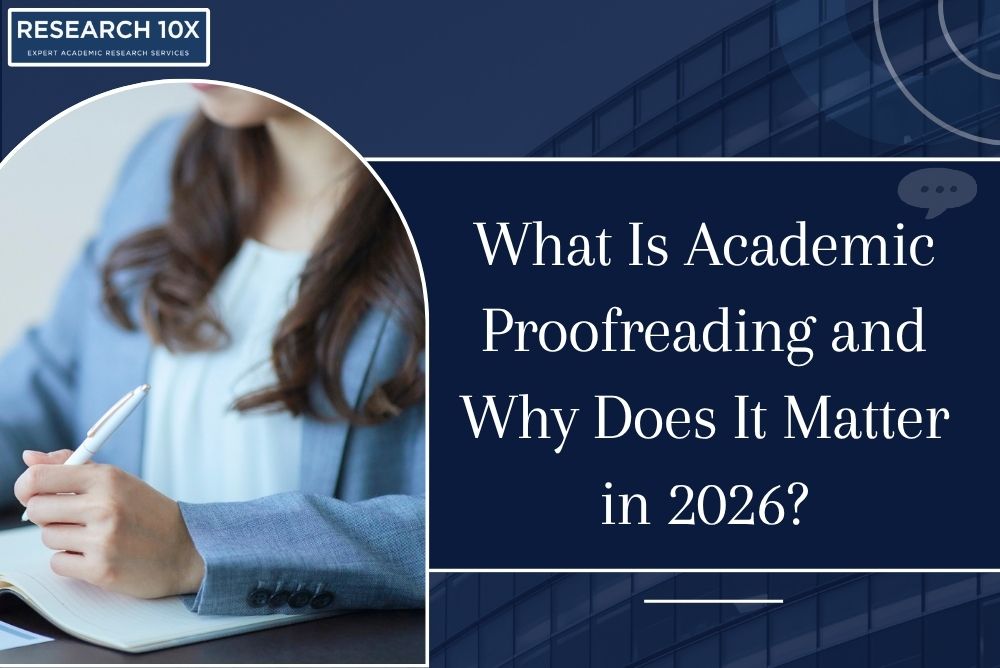
Think of it as the final pass before you hit submit. The goal isn’t to rewrite anything, it’s to catch whatever slipped through: grammar errors, spelling mistakes, punctuation problems, typos, formatting gaps, inconsistent language, and citation issues. All those small things that are easy to miss when you’ve been staring at the same document for weeks.
Proofreading happens after writing and editing are already done. By that point, the content is solid, you’re just making sure the presentation matches the quality of the work itself.
Proofreading vs Editing – They’re Not the Same Thing
A lot of researchers use these words interchangeably, but they serve different purposes.
Editing comes first. It looks at the bigger picture, whether your arguments flow well, whether sentences are clear, whether the structure makes sense. It can involve substantial changes to how content is written.
Proofreading comes after. It’s more precise. It focuses on accuracy, catching errors that editing may have left behind and making sure everything follows the required formatting and citation style.
Many researchers opt for combined Proofreading, Formatting and Editing Services when preparing something high-stakes like a PhD thesis or a journal submission.
Why Proofreading Matters More Than Ever in 2026
Quality expectations from universities and journals have gone up significantly. A paper that reads well doesn’t just score better, it gets taken more seriously.
Credibility starts with how you write
Errors in a research paper can make reviewers question the rigour of the work itself, even when the research is strong. Clean writing signals that the researcher took the work seriously.
Rejection isn’t always about the research
Many manuscripts get rejected or sent back for revision because of language quality, not because the findings are weak. A professionally proofread paper removes that barrier entirely.
It genuinely improves readability
Academic writing is already dense by nature. Proofreading tightens up unclear sentences and removes the small distractions that pull readers away from the actual content.
Citations and formatting matter too
Submission errors in references, headings, or page numbering are more common than you’d think — and proofreading is what catches them before they become a problem.
It helps non-native English researchers compete equally
Most international journals publish in English. For researchers whose first language isn’t English, working with an academic proofreading service bridges that gap and brings their writing up to global publication standards.
Which Documents Actually Need Proofreading?
Honestly, most academic documents benefit from it. The common ones include research papers, journal manuscripts, theses, dissertations, PhD proposals, conference papers, assignments, literature reviews, research reports, and academic books.
If it’s being submitted or published, it’s worth proofreading.
What Does a Proofreader Actually Look At?
Beyond the obvious grammar and spelling, a professional proofreader goes through quite a few layers.
They check language consistency, verb tenses, subject-verb agreement, article usage, sentence construction. They flag spelling inconsistencies, especially between British and American English depending on the target journal. Punctuation is reviewed too: missing commas, run-on sentences, misused semicolons, things that affect how a sentence reads even if the meaning is technically there.
Formatting gets attention as well. Font consistency, heading hierarchy, line spacing, margins, page numbering, academic documents have specific guidelines, and deviations from those guidelines can create real submission problems.
And then there are citations. Whether your document follows APA, MLA, Harvard, Chicago, or IEEE, the proofreader checks that your in-text citations and reference list are consistent and correctly formatted throughout.
How Do You Know If You Need It?
Some clear signs: English isn’t your first language. You’re submitting to a journal. You’re preparing a thesis or dissertation. You’re working under a tight deadline. Your supervisor has asked for language improvements. Or you’re simply not confident about your grammar or formatting.
You don’t need to be struggling with the language to benefit from proofreading, most researchers who use it just want to be sure the document is as strong as it can be before it goes out.
What to Look For in an Academic Proofreading Service
Not every proofreading service understands academic writing. A general editor who’s great with marketing copy might struggle with a research methodology section.
Look for people with actual academic expertise, ideally with subject knowledge in your field. Check whether they have a defined quality process (one round of proofreading isn’t always enough). Make sure they can work within your deadline. And confirm that the service handles documents confidentially, your unpublished research deserves that protection.
Will AI Tools Replace Human Proofreading?
Short answer, not really, not for academic work.
AI grammar tools have improved a lot, but they still miss things that require context. They don’t fully understand discipline-specific terminology, they miss subtle inconsistencies in academic arguments, and they can’t check whether your citation style is being applied correctly throughout a 90-page thesis.
Human proofreading brings contextual understanding, academic language accuracy, and discipline-specific expertise that automated tools still can’t replicate reliably. As journals and universities keep raising the bar, that kind of careful human review will stay relevant.
Frequently Asked Questions
Q 1. What is an Academic Proofreading Service?
An Academic Proofreading Service reviews academic documents to correct grammar, spelling, punctuation, formatting, and language errors before submission.
Q 2. Is proofreading different from editing?
Yes. Proofreading focuses on correcting language and formatting mistakes, while editing improves clarity, structure, and overall writing quality.
Q 3. Who needs academic proofreading?
Students, researchers, professors, PhD scholars, and journal authors can benefit from academic proofreading.
Q 4. When should proofreading be done?
Proofreading should be completed after writing and editing are finished and before final submission.
Q 5. Can proofreading improve journal acceptance chances?
While proofreading cannot guarantee journal acceptance, it can improve language quality and presentation, making the manuscript easier for reviewers to evaluate.