The Three Essential Stages Every Document Needs
You’ve invested your hours into writing and editing your document, and it still just doesn’t feel right. Maybe the text just does not go with the flow, the layout does not look clean, or you seem to be missing the little errors that make it appear unpolished. This is usually where most people get confused between proofreading, formatting, and editing and which one they actually need.
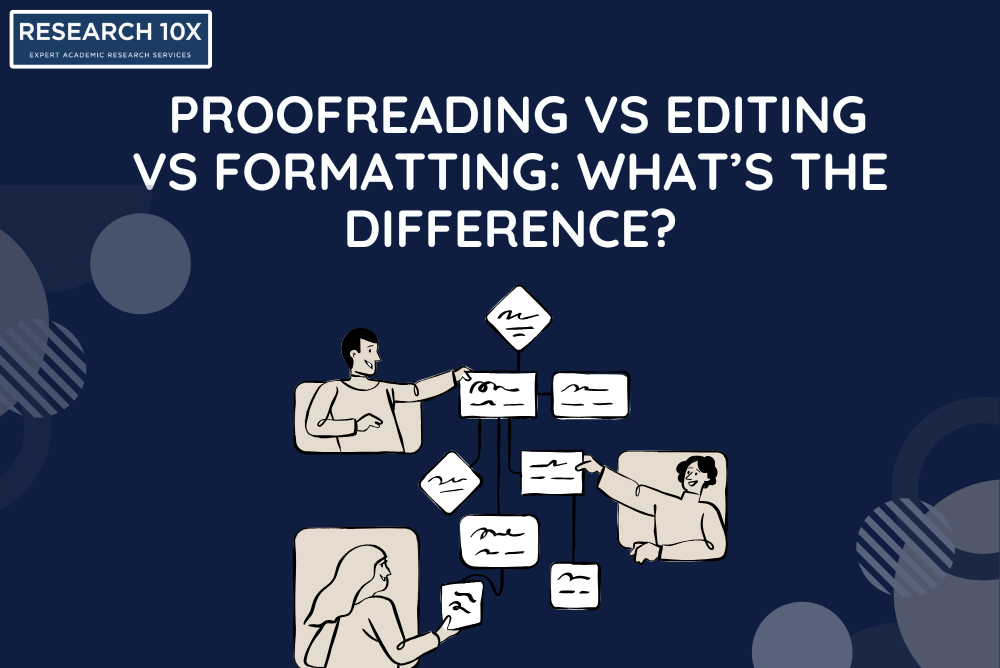
Understanding the difference between proofreading, formatting and editing service will ensure that the content is professional, has credibility, and is ready to be submitted, as all three elements are critical for optimising the work, and neglecting any one stage could reduce the impact.
We at Research10X are constantly seeing fantastic content lose its value due to poor structure, poor formatting, or small, unnoticed errors. Let us break down the three elements so that you can achieve the perfect result every time.
What is Proofreading?
Proofreading is the last stage your document will go through prior to its being published or sent to someone else. This stage aims to spot and rectify any surface-level errors you might have missed in previous reviews.
This process isn’t about changing your content; it’s about giving you error-free, clean work.
Key elements of proofreading:
- Fixing spelling mistakes
- Correcting grammar and punctuation errors
- Checking typos and inconsistencies
- Ensuring uniformity in style (like capitalisation and spacing)
Proofreading is particularly important in academic papers, research documents, and professional writing, where minor errors can impact the credibility of the piece.
Consider proofreading the icing on the cake; your writing has already been completed but just needs the finishing flourish. Your document looks incomplete without it and may seem unprofessional.
What is Editing?
Editing is a far more involved process than proofreading. In editing we work to enhance the quality, structure, and meaning of your work. This is where your ideas are shaped and developed.
Editing can include restructuring the paragraph as well as rewording sentences. It’s a way of making sure that you communicate in a way that can be easily understood, be interesting, and carry meaning.
Types of editing include:
- Structural editing: Improves the overall organization and flow
- Line editing: Enhances sentence clarity and tone
- Copy editing: Fixes grammar while improving readability
Editing helps answer important questions:
- Does the content make sense?
- Is the argument clear and logical?
- Is the tone appropriate for the audience?
Compared to proofreading, editing goes far deeper and ensures a well-drafted piece of work becomes a great persuasive piece of work.
What is formatting?
The concept of formatting relates to appearance, not to the substance of your document. Its function is to produce a document that looks visually uniform, professional, and readable.
Even the best written and most effectively edited work can fail to carry the message if it is not appropriately formatted. Formatting is particularly important when it comes to business reports, academic papers, and research documents.
Key aspects of formatting:
- Consistent font style and size
- Proper headings and subheadings
- Correct spacing and alignment
- Citation and referencing styles (APA, MLA, etc.)
- Page numbering and margins
Formatting makes your work easy to read and guides the reader through it. Good formatting also ensures that you follow a set of particular requirements, especially with academic and professional documents.
Proofreading vs Editing vs Formatting: Key Differences
Knowing the difference between proofreading, formatting, and editing ensures that the correct type of work is performed at the appropriate stage.
Here’s a simple breakdown:
Editing comes first
- Focuses on content quality and clarity
- Improves structure and flow
Formatting comes next
- Enhances visual presentation
- Ensures consistency and style compliance
Proofreading comes last
- Fixes final errors
- Polishes the document before submission
Quick comparison:
| Aspect | Editing | Formatting | Proofreading |
| Focus | Content quality | Visual structure | Surface errors |
| Stage | Early to mid-stage | Mid to final stage | Final stage |
| Changes | Major revisions | Layout adjustments | Minor corrections |
Every step comes after another, if you miss one of the stages, then your document may not look as professional or complete.
Why You Need All Three
Many people assume proofreading alone is enough, but that’s a common mistake. Each process serves a different purpose, and together they ensure your content is fully optimized.
Here’s why all three matter:
- Editing ensures your ideas are clear and impactful
- Formatting makes your document visually appealing and structured
- Proofreading eliminates small errors that can harm credibility
For example, a research paper might have strong insights, but:
- Poor editing can make it hard to understand
- Bad formatting can make it look unprofessional
- Lack of proofreading can introduce distracting errors
When you combine all three, your content becomes polished, professional, and ready to impress.
When Should You Use Each Service?
Knowing when to use Proofreading, Formatting, and Editing can save time and improve results.
Use editing when
- You have a rough draft
- Your content feels unclear or unstructured
- You need to improve readability
Use formatting when
- You need to follow specific guidelines
- Your document looks inconsistent
- You are preparing for submission
Use proofreading when
- Your document is complete
- You want a final quality check
- You are ready to publish or submit
By using the right service at the right time, you avoid unnecessary revisions and ensure better outcomes.
How Research10X Helps You Get It Right
At Research10X, we acknowledge that every document is unique, and the requirements vary. Our services are applicable in any scenario of academic, business, or professional writing, incorporating all three elements of proofreading, formatting, and editing.
We don’t just correct errors, we enhance your entire document to meet high-quality standards.
Our process ensures:
- Clear and impactful writing
- Proper formatting as per guidelines
- Error-free final output
This integrated approach helps you save time while improving the quality of your work.
Ready to Elevate Your Content with Expert Proofreading, Formatting, and Editing?
If you want your document to stand out it needs more than simple editing, however there is no doubt that a well structured, correctly formatted and grammatically accurate document creates a strong impact.
Let Research10X refine your document with our Proofreading, Formatting and Editing service. Research10X can assist you with research papers, thesis or even business documents so that your written work is presented flawlessly and produces exceptional results.
Begin now and develop your draft document into a professional success.